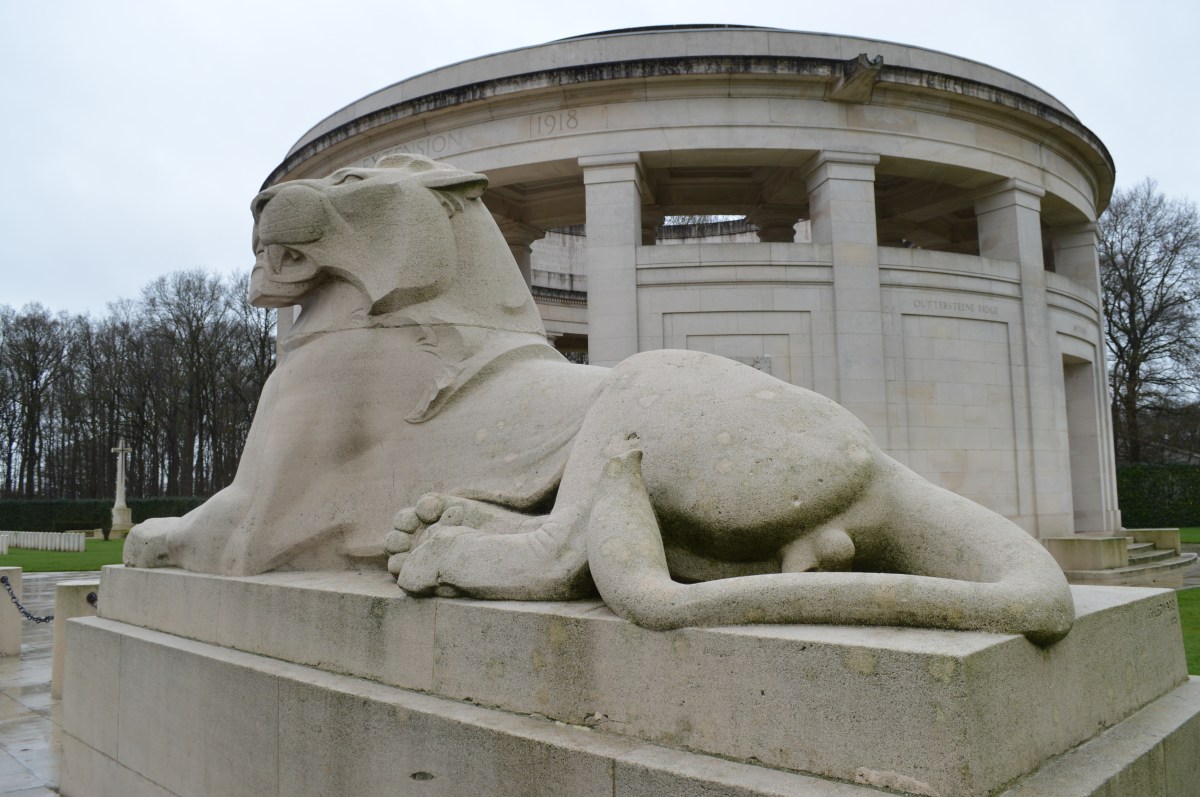
Ploegsteert Wood, known to British troops as Plugstreet, lies approximately eight miles south of the city of Ypres (Ieper) and, technically speaking, just south of the Ypres Salient. There were no major battles fought here, and the wood itself remained mainly in British hands for much of the war. However, men from both sides fought and died in the trenches and dressing stations within and surrounding the wood on a daily basis, and an eerie sensation of stillness and silence can sometimes be felt by those visiting the wood.
Visitors to Ploegsteert will find a combination of cemeteries and memorials in the area which commemorate those who lost their lives in this sector of the Western Front. The Ploegsteert Memorial, unveiled by the Duke of Brabant on the 7th June 1931, commemorates more than 11,000 servicemen of the United Kingdom and South African forces who died in this sector during the First World War and have no known grave. The memorial covers the area from the line Caestre-Dranoutre-Warneton to the north, to Haverskerque-Estaires-Fournes to the south, including the towns of Hazebrouck, Merville, Bailleul and Armentieres, the Forest of Nieppe, and Ploegsteert Wood. The original intention had been to erect the memorial in Lille. It does not include the names of officers and men of Canadian or Indian regiments, as they are recorded on the memorials at Ypres, Vimy and Neuve-Chapelle. Those lost at the Battle of Aubers Ridge, on the 9th May 1915, who were involved in the Southern Pincer are commemorated on the Le Touret Memorial.
The Berks Cemetery Extension, in which the memorial stands, was begun in June 1916 and used continuously until September 1917. At the Armistice, the extension comprised Plot I only, but Plots II and III were added in 1930 when graves were brought in from Rosenberg Chateau Military Cemetery and Extension, about 1 Km to the north-west, when it was established that these sites could not be acquired in perpetuity. Rosenberg Chateau Military Cemetery was used by fighting units from November 1914 to August 1916. The extension was begun in May 1916 and used until March 1918. Together, the Rosenberg Chateau cemetery and extension were sometimes referred to as ‘Red Lodge’.
Hyde Park Corner (Royal Berks) Cemetery is separated from Berks Cemetery Extension by the N365. It was begun in April 1915 by the 1st/4th Royal Berkshire Regiment and was used at intervals until November 1917. Hyde Park Corner was a road junction to the north of Ploegsteert Wood. Hill 63 was to the north-west and nearby were the ‘Catacombs’, deep shelters capable of holding two battalions, which were used from November 1916 onwards.
Strand Military Cemetery lays a few hundred yards along the N365 leading from the Ploegsteert Memorial and stands at a point known by British Troops as ‘Charing Cross’. This was a point at the end of a trench called the Strand, which led into Ploegsteert Wood. The cemetery was not used between October 1914 and April 1917, but in April-July 1917 Plots I to VI were completed. Plots VII to X were made after the Armistice, when graves were brought in from some small cemeteries and from the battlefields lying mainly between Wytschaete and Armentieres.

 In The Frontline